

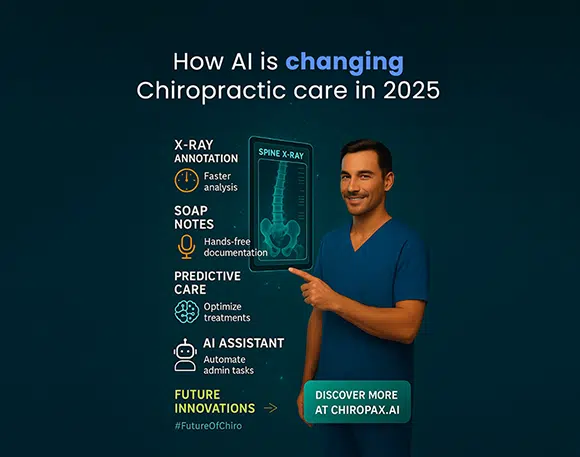
Hey chiropractors — a few years ago, AI in chiropractic care was just a cool tech idea. Today it’s transforming how you diagnose, document, and care for patients. And it’s not only about speed — it’s about being more accurate, more consistent, and giving you more time with patients instead of paperwork.
If you’re still relying on old manual methods, the gap is widening.
Where AI makes the difference
Five shifts happening right now
01 — Imaging
📸 Smarter X-Ray Annotation
Forget the clicks, the rulers, and the 10+ minutes spent marking every vertebra. AI detects spinal landmarks automatically and calculates cervical lordosis, Cobb angles, disc-space narrowing, and vertebral translation in seconds, with clean, color-coded results.
One algorithm measures every film the same way — so your visit-to-visit progress comparisons finally hold up. It even produces report-ready AOMSI documentation for personal-injury cases following AMA Guides.
02 — Documentation
📝 Auto-Generated SOAP Notes
Documentation is the quiet productivity killer — but not anymore. AI scribes listen as you work and build your SOAP notes in real time. No more late-night typing. Save time, reduce errors, and stay compliant without breaking your flow. You review and sign off; the AI handles the first draft.
03 — Foresight
🔮 Predictive, Personalized Care
AI turns patient data into foresight. By analyzing trends across a patient’s history, it can flag re-injury risk, surface unusual patterns early, and support personalized care plans. An extra set of eyes that never tires — informing your judgment, never replacing it.
04 — Operations
🤖 AI Assistants for Admin & Engagement
Let AI handle the repetitive load — appointment reminders, follow-ups, rehab instructions, and check-ins. Patients stay on track, your team stays focused, and your clinic runs smoother without extra hires.
05 — Infrastructure
🔗 EHR & PACS Integration
The value multiplies when it all connects. More platforms now integrate with electronic health records (EHR) and cloud PACS, so images, measurements, notes, and reports live in one place. DICOM-first workflows take you from image to documentation with far fewer manual steps.
On the horizon
What's Next?
Wearable spine trackers, AI-generated rehab plans, deeper EHR/PACS integration, and remote pre-analysis tools are on the way. The clinics adopting AI now will move faster, work smarter, and grow with less burnout.
The bottom line: In 2025, AI isn’t optional — it’s your competitive edge. Clinics using it save hours weekly, standardize diagnostics, deliver better care faster, and scale without burning out their teams. None of it replaces your expertise; it clears the busywork so your expertise goes further.
Questions chiropractors ask
Frequently Asked Questions
See AI in action
ChiroPax brings medical-grade AI X-ray analysis and instant reporting into your workflow — in seconds.

